Dirt Bike Brake Lines
That Don’t Fold When the Trail Pushes Back
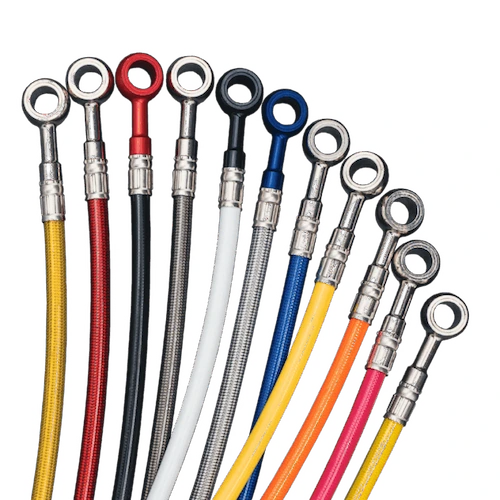
GBrakes® Dirt Bike Brake Lines use a stainless steel braid over a PTFE core to maintain sharp lever response under punishing heat, mud, and rock strikes. Each line is laser-measured, route-verified, and pre-bled for exact fitment and fast install. Designed for serious elevation changes and creek crossings, these lines won’t flex, swell, or rub out when the trail gets rough. Start building your dirt bike line setup here.
Trails don’t hold mercy. Out there, brake lines aren’t optional. They’re the only thing standing between controlled descent and blown corners. Stock rubber hoses swell under heat, flex through suspension travel, and wear fast from rock hits and abrasion. That’s how you lose pressure, lever feel, and braking consistency when it matters most. GBrakes® Dirt Bike Brake Lines are built to take it. Every line uses a high-temp PTFE inner core that won’t expand under heat or pressure. We wrap it in stainless steel braid to resist rock strikes, trail snags, and rough weather. This combo keeps lever response sharp and braking predictable, no matter how long the descent or how deep the mud.
Each line is spec’d and cut to your bike’s exact routing, no bind, no slack, no rub. Every set is laser-measured, route-verified, and pre-bled for fast install and immediate feedback. These lines are ready for serious elevation changes, step-downs, fire roads, and creek crossings, not just coffee shop crawls. If your ride goes where others tap out, this is the brake line that holds pressure and control all the way down. Built in the USA, tested on real trails, and ready to take hits.
Factory hoses are fine, until they’re not. That moment on the trail where you grab a handful of brake and the lever fades. Or worse, when a flexed-out hose rubs raw against the frame, starts leaking, and your whole system goes soft without warning.
Here’s what goes wrong with OEM dirt bike brake lines
Internal Collapse
Abrasion Failures
Poor Suspension Travel Tolerance
Crimp Failures
What Gbrakes® Lines Fix
High-Flex Routing Geometry
Abrasion-Resistant Jacketing
Stainless Steel Fittings
Pre-Bled + Pressure Tested
Consistent Lever Feel, Every Time
Install it once. Ride it hard. Forget it’s even there, until you need to stop in a hurry. Then it matters.
Browse below for Dirt Bike Brake Lines
We spec by use, weight, and real ride conditions, not catalog filler. Fixed, floating, oversized pick based on how you ride. We’ll make sure it stops.
Showing 1417–1420 of 1420 results

Trail-Tested Weak Links OEM Hoses Can’t Handle
Rubber hoses are widely used because they’re cheap—but cheap doesn’t mean reliable. These hoses fail under multiple trail-stress scenarios:
Heat-induced swelling:
- Rubber cores expand after repeated braking on long descents.
- Expansion consumes brake fluid pressure, making the lever mushy.
Structural fatigue:
- Continuous bending over triple-clamps under suspension movement weakens hoses.
- Over time, the hose core delaminates, causing delayed lever feel.
- Fine grit woven into the braid works like sandpaper on hose sleeves.
- One unprotected contact point under tension is all it takes to puncture.
- Rubber hoses absorb moisture, lowering boiling points.
- Once the fluid boils, the system becomes spongy—and risky.
Upgrade Features That Influence Real Riding Experience
Here’s why Gbrakes® lines turn average rides into upgrades you feel:
fail under multiple trail-stress scenarios:
Hydrophobic core with zero thermal expansion:
- Designed to maintain firm lever feedback through repeated heavy use.
- Repels moisture, so brake fluid stays dry and pressure-ready.
304 stainless braid, full-length coverage:
- Protects against rock strikes and trail wear—not a marketing sleeve, it's real armor.
- Seamless routing through clamps, no zip-tie reroutes, no risk of rubbing under full lean.
- Sealed to resist dust, water, and trail grit—no weepy lines mid-ride.
- Delivered ready to go. No chase for bubbles or bleed after first ride.
- Walls aren’t hype—tested under pressure that crushes most competitors.
Immediate Feedback You Can Feel Start to Finish
After install, riders consistently report:
- Sharper lever bite within first squeeze
- No fade through long braking sequences
- Firm, repeatable leverage across terrain transitions
- No need for early-season bleeds
- No visible wear despite heavy use
- Confidence: when you hit the lever, it responds, every time
We’ve built lines that don’t just connect points – they connect you to your ride.
Step-by-Step Install for Trail Integrity
- Match hose length to suspension specs—don’t stretch or bind.
- Route along factory paths; avoid exhaust and rotating parts.
- Don’t reuse crush washers or ferrules.
- Torque fittings to OEM specs; no brute force.
- Use DOT 4 or DOT 5.1 fluid to maintain high boiling points.
- Cycle the lever until firm, then back bleed if necessary.
- Compress suspension to limit height, confirm no drag or rope bend injuries.
- Inspect after first ride; re-check torque and mounting orientation.
Install once, ride hard, and never second-guess.
What These Lines Mean for Your Braking Setup
Most riders look at rotors last. Don’t. It’s the most overlooked upgrade in a braking system, but arguably the most important after pads. Here’s what the experts know:
- Matched fidelity: Remains consistently tight even with upgraded pads and rotors.
- System resilience: Once installed, wear becomes predictable and controlled.
- Operational simplicity: No seasonal bleed or hose-rotate troubleshooting needed.
- Incremental gains: Leverage returns to optimal when paired with step-up upgrades.
- Modular upgrade path: Lines first—then rotors, pads, and braking blades fall into place naturally.
Brake lines are the foundation of your braking system. Everything else, pads, rotors, masters, relies on the integrity of the lines. Start there. Stay installed. Leave soft brakes behind.
Live fast. Brake Faster.